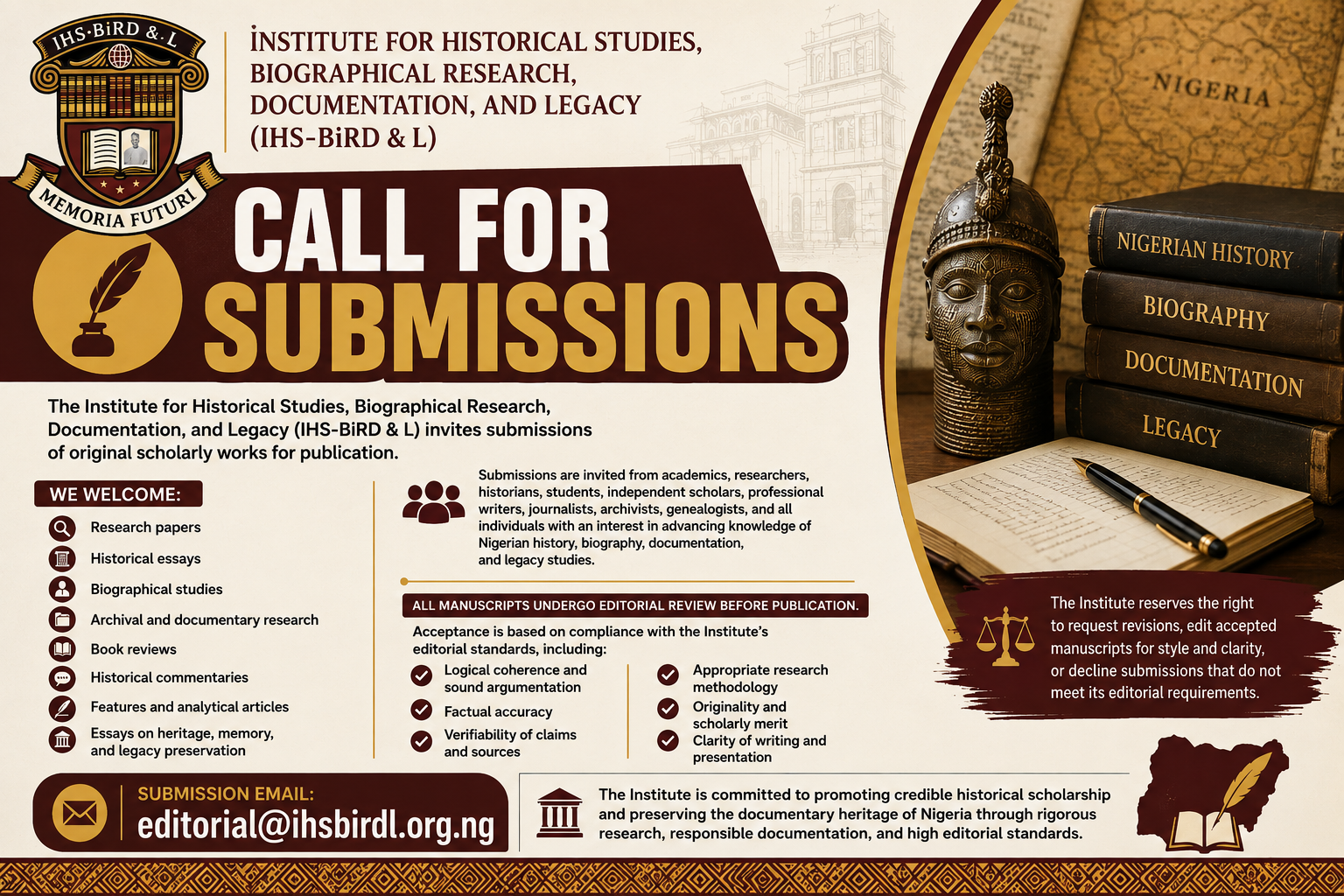
Call for Submissions
The Institute for Historical Studies, Biographical Research, Documentation, and Legacy (IHS-BiRD & L) invites submissions of original scholarly works for publication on this space.
We welcome:
* Research papers
* Historical essays
* Biographical studies
* Archival and documentary research
* Book reviews
* Historical commentaries
* Features and analytical articles
* Essays on heritage, memory, and legacy preservation
Submissions are invited from academics, researchers, historians, students, independent scholars, professional writers, journalists, archivists, genealogists, and all individuals with an interest in advancing knowledge of Nigerian history, biography, documentation, and legacy studies.
All manuscripts undergo editorial review before publication. Acceptance is based on compliance with the Institute's editorial standards, including:
* Logical coherence and sound argumentation
* Factual accuracy
* Verifiability of claims and sources
* Appropriate research methodology
* Originality and scholarly merit
* Clarity of writing and presentation
The Institute reserves the right to request revisions, edit accepted manuscripts for style and clarity, or decline submissions that do not meet its editorial requirements.
Submission Email:
The Institute is committed to promoting credible historical scholarship and preserving the documentary heritage of Nigeria through rigorous research, responsible documentation, and high editorial standards.
Note: Submissions that satisfy the more rigorous editorial and peer-review requirements of the Institute's planned scholarly journal, to be announced in due course, may be selected for publication in that journal.
Artificial Intelligence (AI) Policy
The Institute for Historical Studies, Biographical Research, Documentation, and Legacy (IHS-BiRD & L) recognises the growing role of artificial intelligence (AI) in research, writing, editing, and knowledge management. While AI may be used to support aspects of the editorial and research process, it does not replace scholarly judgement or editorial responsibility.
Our use of AI is guided by the following principles:
Human Oversight
All AI-assisted submissions are subject to review, verification, and approval by qualified human editors before publication. Editorial decisions remain the responsibility of the Institute.
Credibility and Accuracy
AI-assisted material must meet the same rigorous standards of factual accuracy, verifiability, logical consistency, and scholarly integrity required of all published works. Contributors remain responsible for the accuracy of their submissions.
Ethical Use
AI shall be used only in ways that uphold the dignity, reputation, and rights of individuals, institutions, communities, and historical subjects. The Institute will not knowingly publish AI-generated misinformation, fabricated citations, or misleading content.
Data Privacy
The Institute is committed to protecting the privacy and personal information of contributors, research participants, archival sources, and publication subjects. AI tools shall be used in a manner that respects confidentiality, applicable laws, and recognised ethical standards.
The Institute encourages responsible innovation while maintaining the highest standards of historical research, documentation, and scholarly publishing.