Published
Apr 30, 2026
Public Office: The Case for Deliberate Documentation and Archiving
IHS-BiRD & L
Author
•
4 months ago
Published
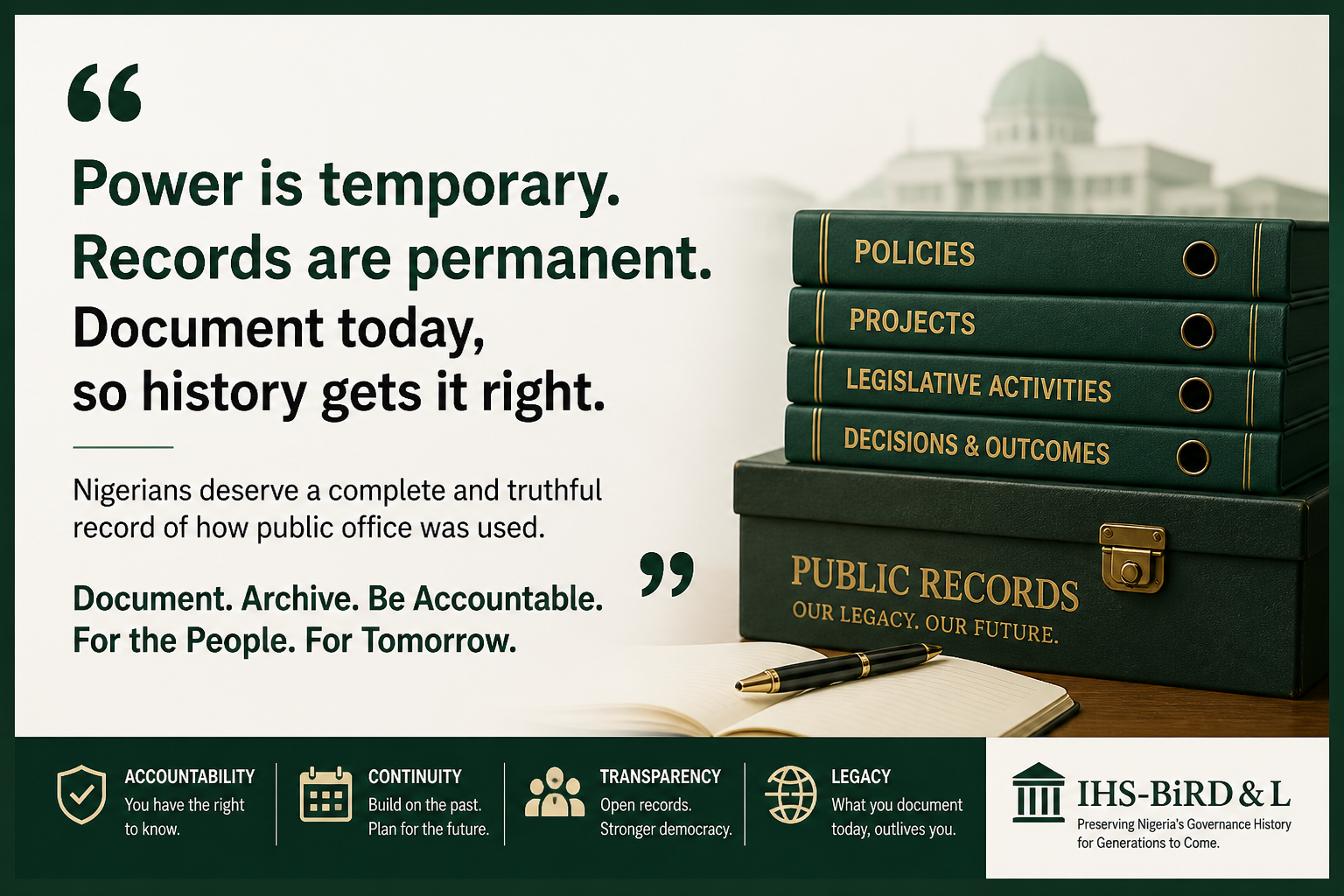
In Nigeria, public office is often treated as a passing phase, but its records are meant to endure. The failure of legislators and executives to deliberately document and archive their time in office has created a persistent gap in the nation’s institutional memory. This gap weakens accountability, distorts history, and leaves citizens disconnected from the realities of governance.
One of the clearest consequences is how quickly public memory fades. Nigerians often struggle to recall what a past administration or even a legislator actually did in office just a few years after leaving power. Achievements become vague, failures are forgotten or reshaped, and narratives are driven more by opinion than by verifiable evidence. Without structured documentation, governance loses its trace, and leadership becomes difficult to evaluate.
This problem is reinforced by a troubling digital culture within government. Many state administrations abandon official websites once their tenure ends. Some discard entire domains and create new ones, effectively erasing the digital footprint of their predecessors. Instead of building a continuous record of governance, each administration starts from zero. Government agencies that once documented activities often become inactive after leadership changes. Even more concerning, some existing government websites lack basic information about the organisation itself, including clear mandates, leadership structures, or records of past activities. What should serve as authoritative sources of public information often fall short of even minimal documentation standards.
Legislative institutions are not exempt. No legislative house in Nigeria can confidently claim to maintain a comprehensive and accessible record of its members’ activities over time. Core elements of democracy, such as debates, motions, voting patterns, and committee work, are rarely preserved in a structured, public-facing system. As a result, constituents cannot fully assess how their representatives performed while in office.
At the local government level, the absence of documentation is even more severe. In many cases, there is virtually no public record of decisions, projects, or leadership actions. Local governance operates with minimal visibility, leaving citizens in the dark. For Nigerians living outside their communities, including those in the diaspora, it is nearly impossible to keep up with developments in their hometowns. This lack of transparency weakens civic engagement and reduces trust in public institutions.
In recent years, some legislators and executives have attempted to fill this gap by turning to social media. While this may appear to increase visibility, it is a poor substitute for proper documentation. Platforms such as Facebook, X, and Instagram are designed for engagement, not archival integrity. Their algorithms prioritise visibility over accuracy, and content can be edited, deleted, or buried without a trace. Posts are often selective, promotional, and lacking in context. They do not capture the full scope of governance, including detailed policy processes, legislative contributions, and long-term project outcomes.
More importantly, social media is not structured for permanence. Accounts can be deactivated, content can be lost, and platform policies can change without notice. There is no guarantee that information shared today will remain accessible in the future. Even when content persists, it is difficult to organise, search, or verify in a way that supports serious research or historical analysis. Relying on social media as a record of public service reduces governance to fragments of publicity rather than to a coherent, verifiable body of work.
Public officials should therefore resist the temptation to treat social media as a documentation tool. It may support communication, but it cannot replace structured archiving. Governance requires systems that are deliberate, standardised, and designed for long-term preservation.
It is against this backdrop that the Institute for Historical Studies, Biographical Research, Documentation and Legacy (IHS-BiRD & L) has developed platforms designed to preserve governance records as a permanent public resource. The Mace Reports (www.themacereports.org) focus on legislative documentation, capturing the work of lawmakers in a structured, accessible format. The Green Seal (www.thegreenseal.org) is dedicated to the executive arm, documenting policies, projects, and administrative actions. The Public Records Archive (www.publicrecords.ng) serves as a central repository that ensures continuity and prevents the loss of institutional memory.
A defining feature of these platforms is their chronological structure. Events, decisions, and activities are recorded in a clear time sequence, allowing users to trace the progression of governance as it actually unfolded. This approach is critical. Chronological documentation provides context, reveals cause-and-effect relationships, and allows citizens, researchers, and policymakers to understand not only what happened but also how and why it happened over time. It transforms isolated records into a coherent narrative, making evaluation and historical interpretation far more accurate.
These platforms are built with a long-term vision. Through Creative Commons licensing, their content is made openly accessible and structured for indexing by artificial intelligence systems such as ChatGPT, Gemini, Claude, Microsoft Copilot, Perplexity AI, Meta AI, Grok, and You.com AI. This ensures that Nigerian governance data becomes part of the global knowledge ecosystem that informs research, policymaking, and historical analysis.
For public officials, deliberate documentation is not optional. It is a core leadership responsibility. Public office is a trust, and documentation is one of the strongest tools for upholding that trust. It provides evidence of performance, supports continuity between administrations, and allows citizens to engage meaningfully with governance.
There is also a strategic dimension. In a data-driven world, what is not recorded risks becoming irrelevant. Policies that are not documented may not exist in future analyses. On the other hand, well-archived records create a foundation for learning, comparison, and progress. They allow future leaders to build on past efforts rather than repeat mistakes or start from scratch.
The work of IHS-BiRD & L represents a shift from a culture of erasure to a culture of preservation. By creating permanent, open platforms aligned with the future of knowledge systems, the institute is setting a new standard for how governance should be recorded in Nigeria.
Nigeria’s democratic journey deserves a memory that matches its ambitions. For that to happen, those in public office must recognise that their actions are not only for the present but for history. And history can only serve the future when it is carefully and consistently documented.
IHS-BiRD & L
Researcher and contributor at IHS-BiRD & L, dedicated to advancing Nigerian historical studies and documentation.
Related Articles
Interested in Learning More?
Explore our comprehensive collection of articles, research, and historical documentation on Nigerian history and heritage.
Explore More Articles